The mechanism seen by tomography
Original computed tomography slices of Fragment A, downloaded from the public Harvard Dataverse repository.
Computed tomography (CT) images the object with X-rays from thousands of angles and reconstructs its interior on a computer, layer by layer. This reveals the gears hidden inside the corroded bronze, without touching the fragment.
The images on this page are original slices of scan A6 of Fragment A, the largest. The data were gathered in Athens in 2005 by X-Tek Systems and are published on Harvard Dataverse (Antikythera Fragment A scan A6), together with the paper by Pakzad et al. in PLOS ONE (2018). They were downloaded from there and resized for the web; the text under each image states where it comes from.
The slices are parallel to the gears, one every 0.1 mm: 544 in all, from the front to the back of the fragment. Eight are shown here.
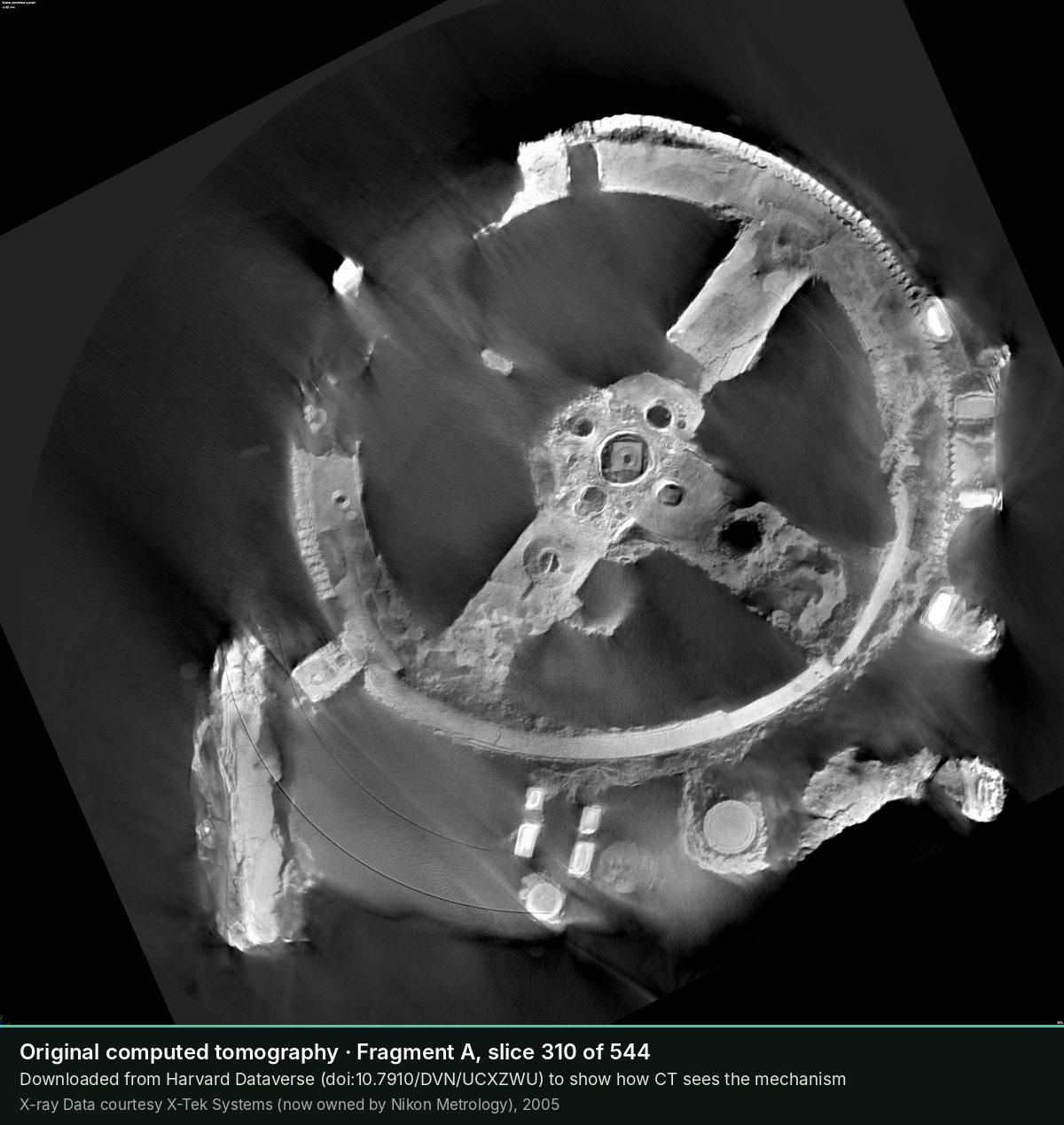
The main wheel b1, with its four spokes and central hub.
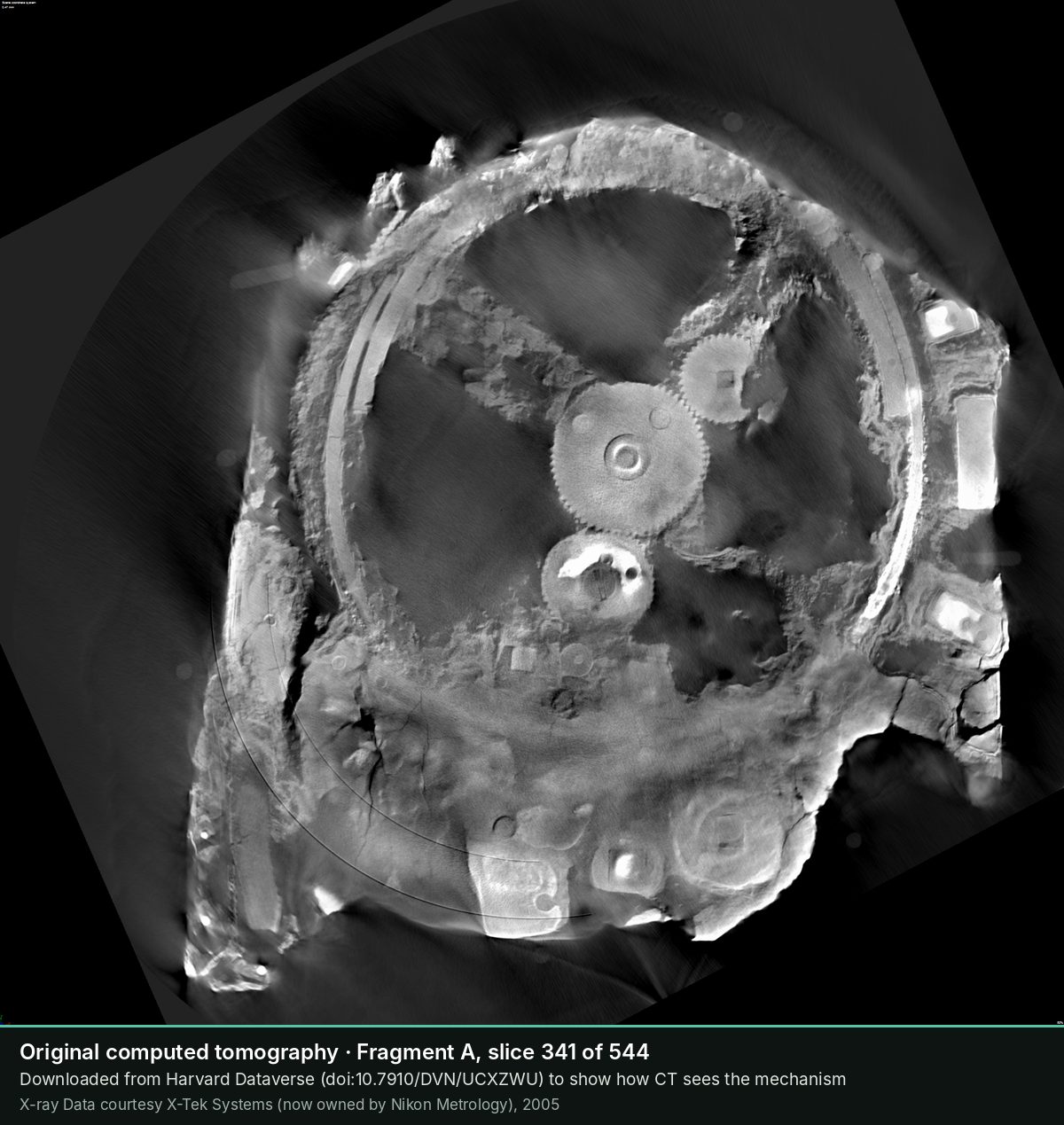
At the centre of b1 the gear b2, with a smaller gear meshing with it.
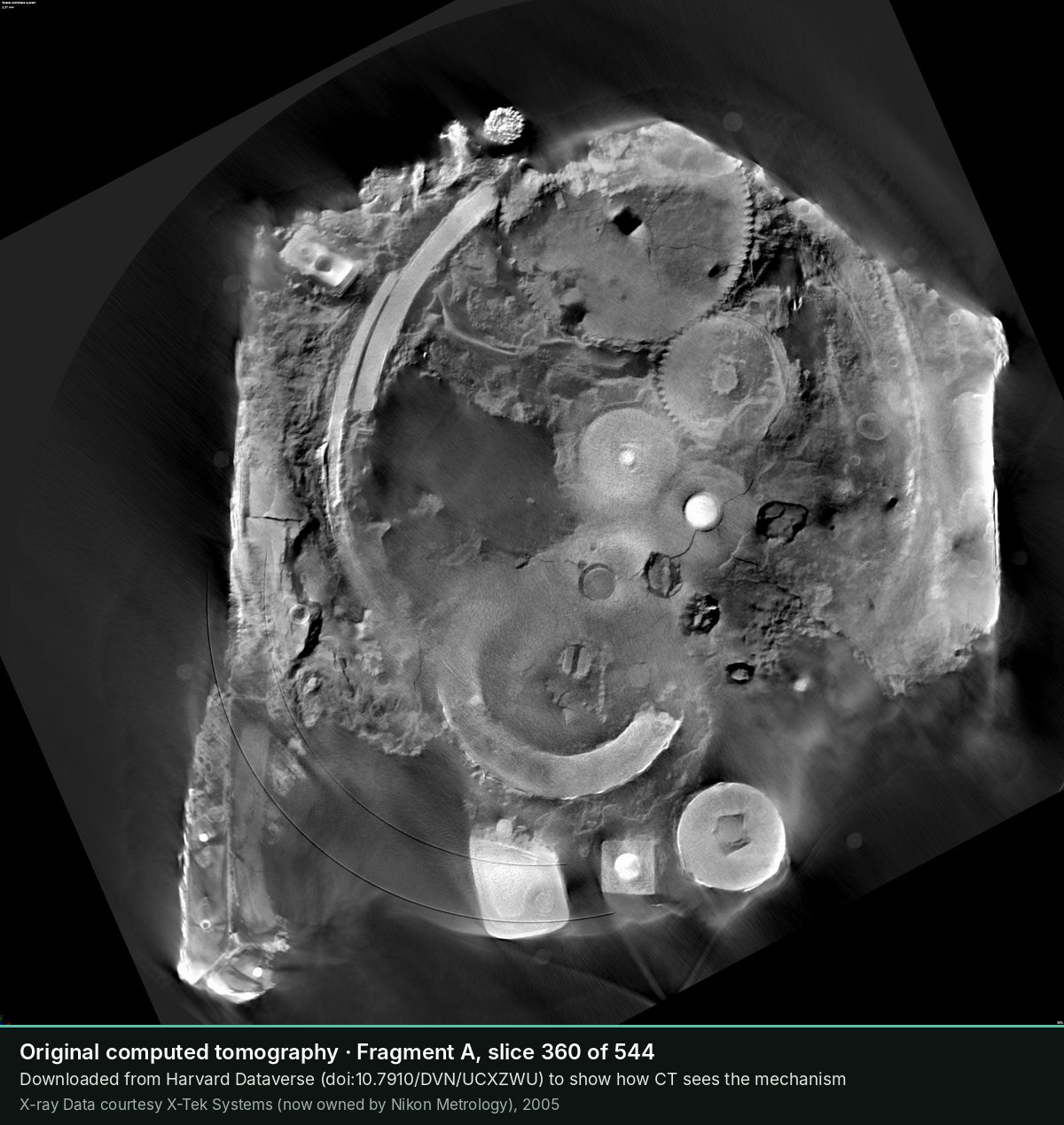
Behind b1, more gears appear.
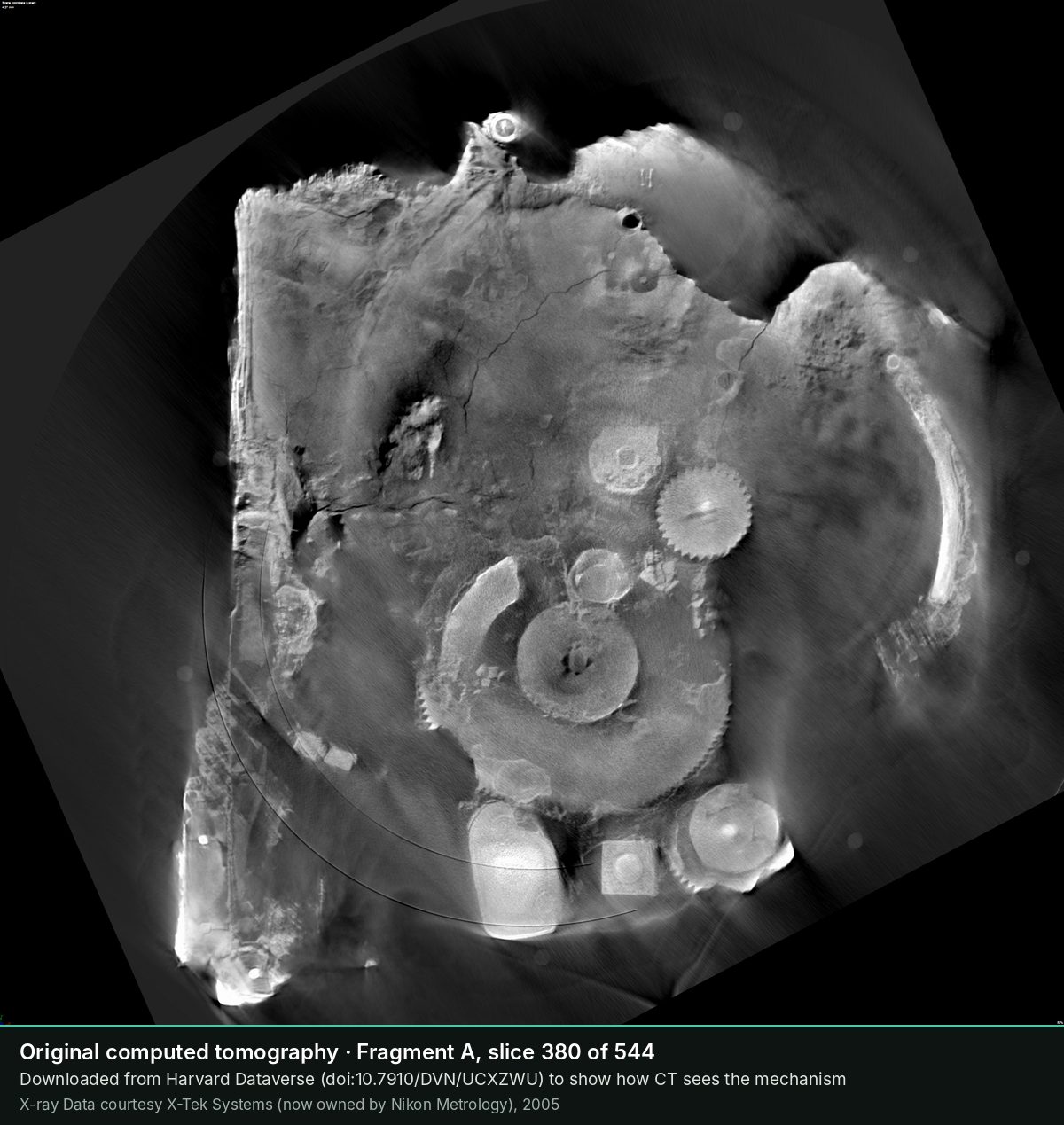
Deeper: a large disc and smaller gears.
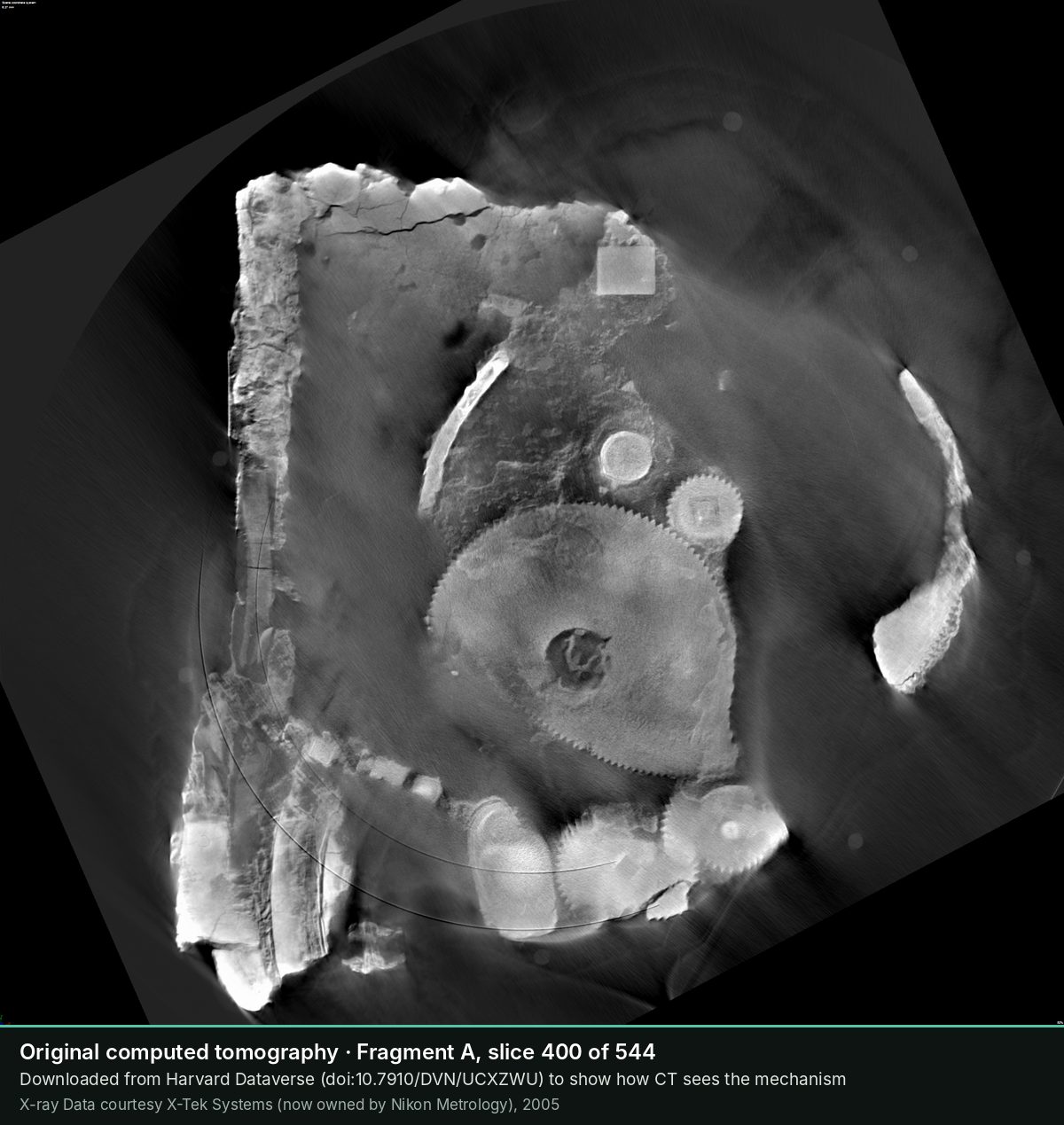
A large, finely toothed wheel, with a small gear meshing with it.
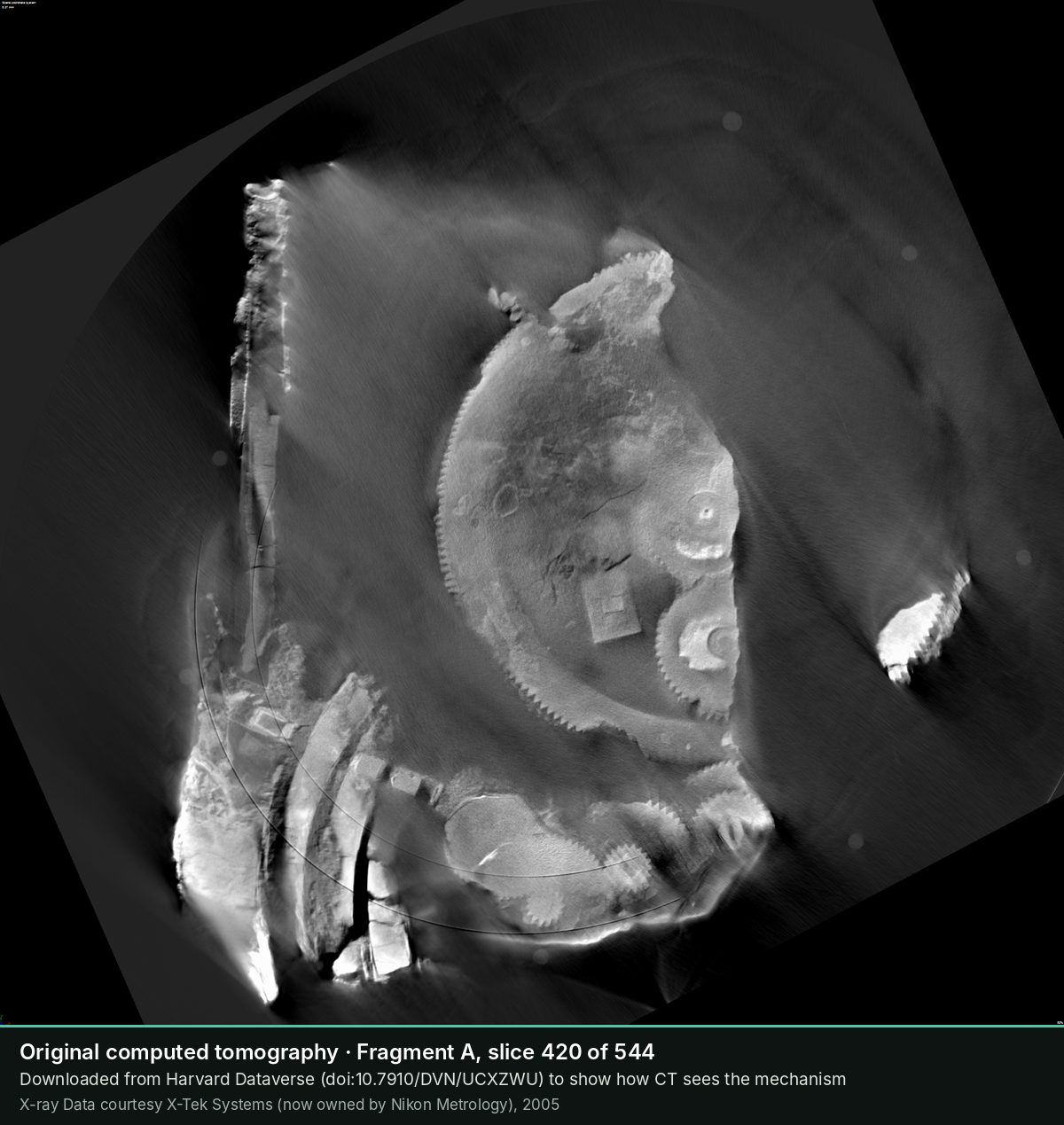
The toothed rim of a large wheel and, on the right, smaller gears.
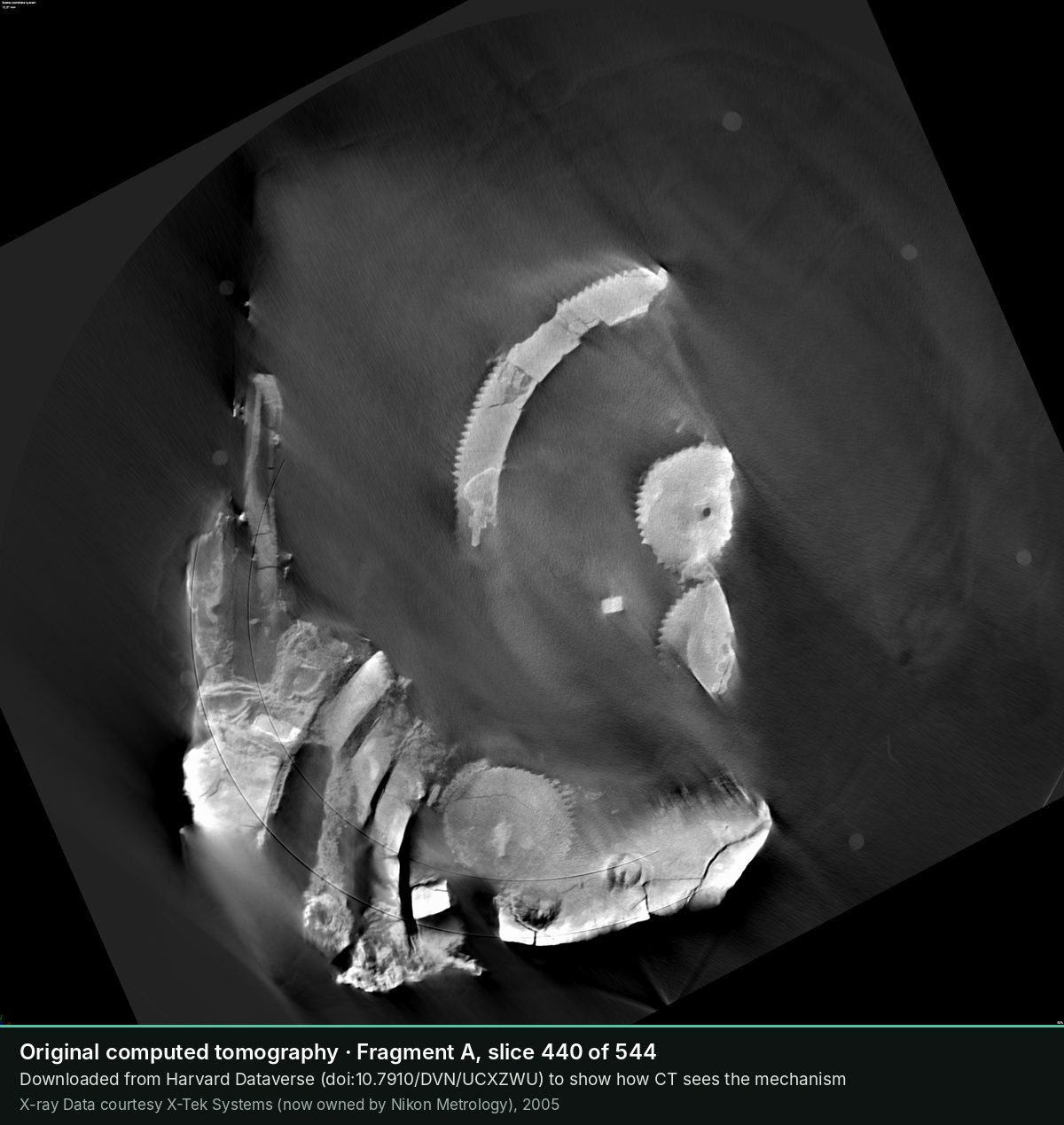
Towards the back: the toothed arc of a large wheel and two smaller gears side by side.
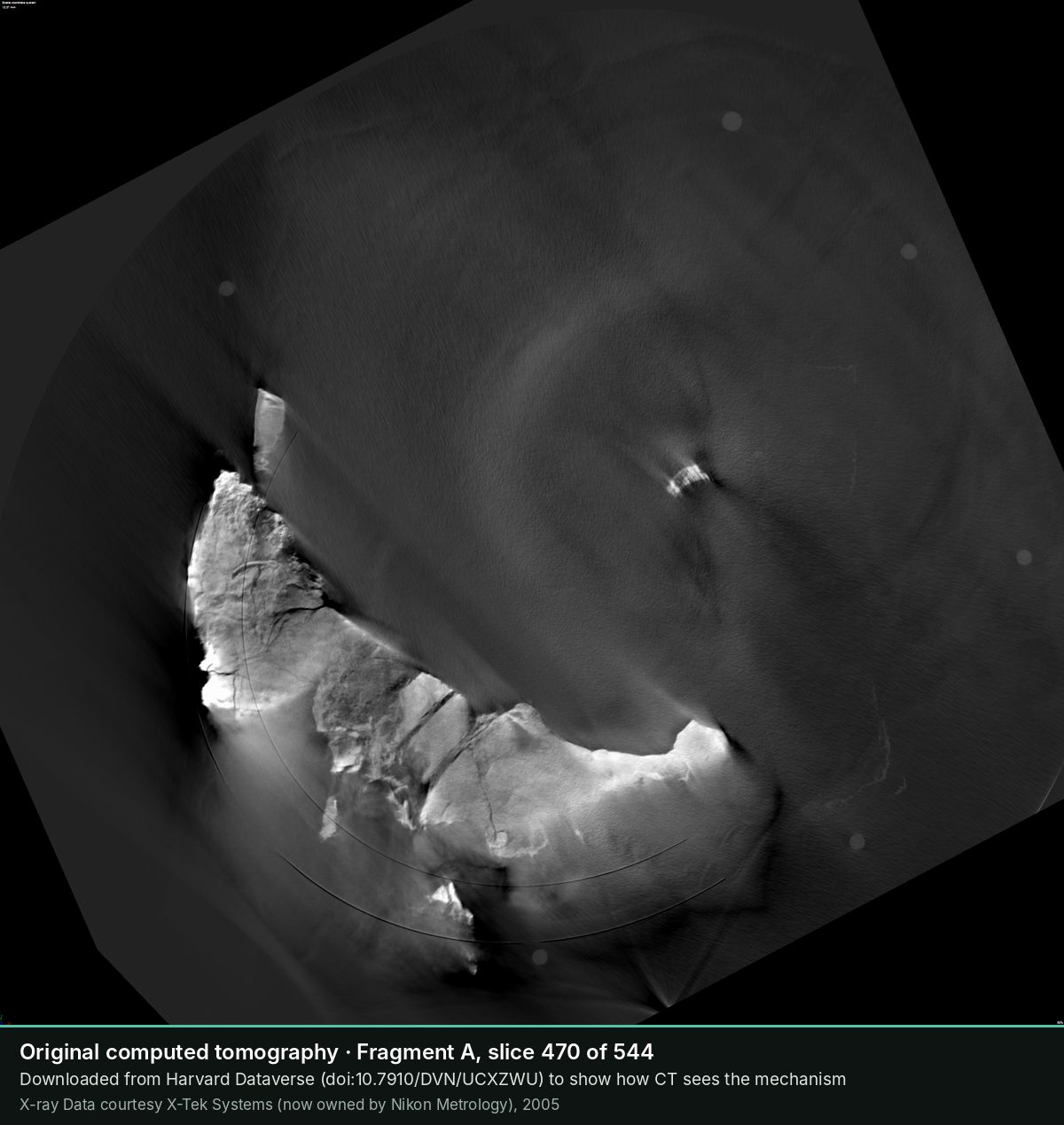
The back of the fragment: a flat plate.
Credits
Data: Antikythera Fragment A scan A6, Harvard Dataverse, doi:10.7910/DVN/UCXZWU (deposited by Adam Gibson, UCL). X-ray Data courtesy X-Tek Systems (now owned by Nikon Metrology), 2005. Equipment loaned by X-Tek Systems Ltd (now owned by Nikon Metrology) was used to collect the data. The data are distributed under a Creative Commons Attribution (CC BY) licence.
Join the development
Join the development of the first scientifically guided, buildable Antikythera experience: schools, museums, researchers, makers.
Join the Project →